
Buchanan Parole Versus Probation
Virginia separates the parole decision from field supervision. The Virginia Parole Board decides parole for eligible people. VADOC Community Corrections supervises parolees and people placed on probation by a court. Both may appear in the VADOC Inmate and Supervisee Locator, but the source of authority remains different.
| Point | Parole | Probation |
|---|---|---|
| How it begins | Conditional release from incarceration under parole law | Court judgment, often with suspended incarceration |
| Decision record | Virginia Parole Board action and VADOC release papers | Buchanan sentencing or later court order |
| Supervisor | VADOC Community Corrections | VADOC Community Corrections |
| How to verify | Locator, Board report, release documents, district | Locator, court order, district |
| How it ends | Discharge or other lawful Board/VADOC action | Completion or court action under the order |
- Parole
- Supervised release from incarceration for a sentence that remains parole eligible.
- Probation
- Supervision ordered by a court, sometimes after a jail term and sometimes without prison release.
- Supervisee
- A person shown by VADOC as under community corrections oversight.
- Discharge
- The documented end of the relevant custody or supervision term.
- Absconder
- A supervisee alleged to have stopped reporting or left supervision without authorization.
Modern Virginia sentences can include post-release supervision even though discretionary parole was generally abolished for covered felony offenses committed after the statutory cutoff. The label on the court order matters. Do not call every community-supervision term parole or infer its legal basis from the locator alone.
Verify Buchanan Post-Release Supervision
The VADOC Inmate and Supervisee Locator is the first online check. It is updated daily and covers people under VADOC custody or supervision. A matching community-supervision entry supports release from the prison setting, but it does not describe an unrelated SWVRJA jail episode.
- Search with the seven-digit VADOC ID when available. Otherwise use the first three letters of the first name and the full last name.
- Confirm identity using the displayed biographical details. Do not rely on a common name alone.
- Read status, location, and supervising district together. “In custody” is not a community release.
- Check the Buchanan sentencing order for probation or the Virginia Parole Board report for a parole decision.
- Call the listed district to verify the assigned reporting site and current public contact route.
A fully discharged person may fall outside the locator’s stated custody-or-supervision scope. In that case, use VADOC release documents, the inactive-offender records process, or the court’s final order. The Buchanan County release-record search explains how the local jail and state systems fit together.
Read the result as a current VADOC statement, not as a permanent supervision archive. The displayed district identifies the present corrections relationship when the record is in scope. The Buchanan judgment supplies probation terms, while a Parole Board action and VADOC papers supply the parole path. Agreement among those sources is stronger than any one saved screen.
Buchanan Supervision Uses District 43
VADOC lists Tazewell District 43 with an additional office in Buchanan and assigns it Buchanan and Tazewell counties. The published main contact is in Cedar Bluff. The “additional office” notation does not provide a public Buchanan walk-in address, so call before travel and confirm the person’s actual reporting location.
VADOC Probation and Parole District 43134 Taylor Road
Cedar Bluff, VA 24609
Mail: P.O. Box 363, Pounding Mill, VA
276-963-3092
The district shown on a current locator record controls more than county geography. Assignments may follow residence, transfer, or agency decisions. A Buchanan home address is not enough to infer the office. Use the VADOC facilities and offices directory to recheck the current listing.
The official VADOC directory image below shows the facility and District 43 source used for Buchanan release supervision.
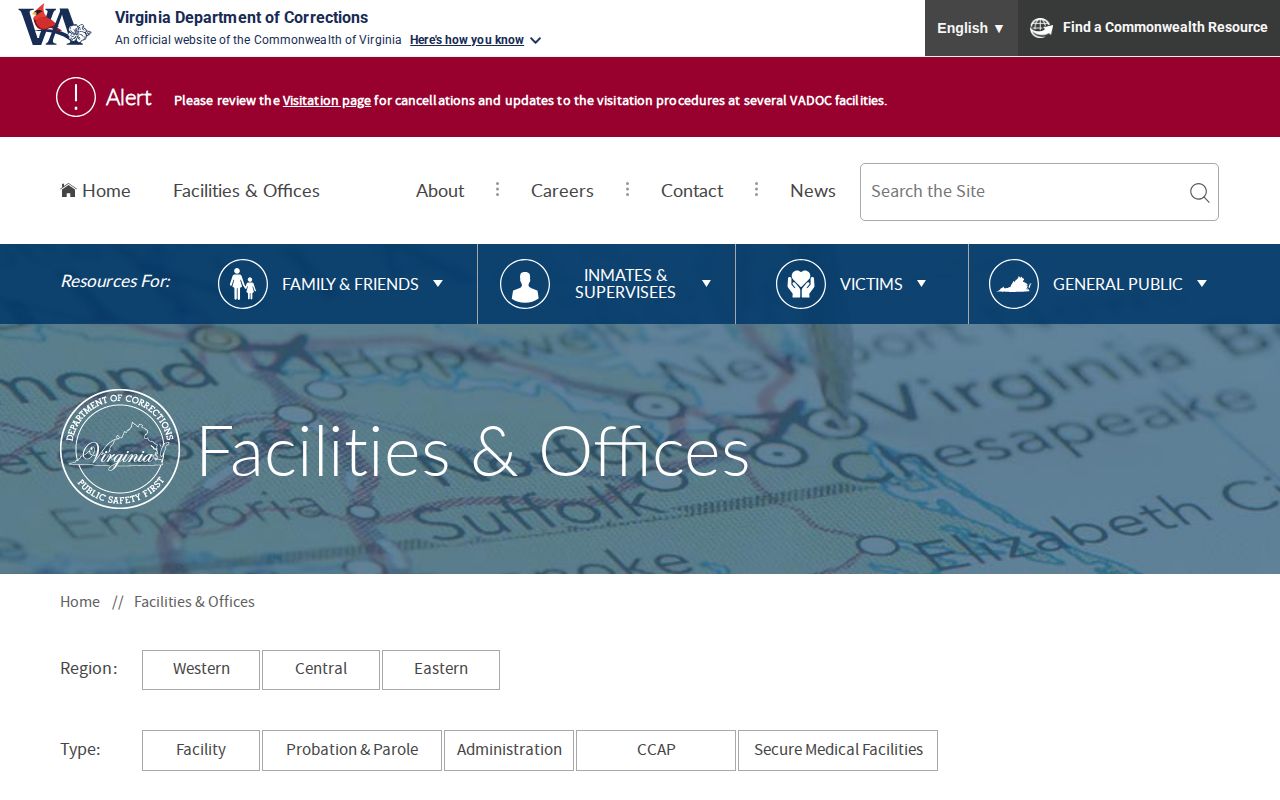
That directory should be checked again before a visit because office contacts and assignments can change.
Buchanan Violations and Warrant Limits
Supervision conditions come from the signed release or court documents. They can address reporting, travel, treatment, conduct, and other case-specific duties. A violation allegation may lead to district action, a court capias, a Parole Board warrant, arrest, or a hearing. The exact response depends on the governing order and agency.
The VADOC locator is not a complete warrant database. A stale entry, a missing name, or an unexpected location does not prove a warrant or compliance. VADOC’s Most Wanted page is also a selected fugitive list, not a full search. Verify through District 43, the Buchanan court docket, or an official law-enforcement warrant channel.
VADOC explains that officer arrest warrants, court capiases, and Parole Board warrants are filed with law enforcement. Its anonymous tip line is 877-896-5764. Do not approach or try to apprehend anyone.
Buchanan Supervision Discharge Records
Release from a cell and discharge from supervision are separate events. A parolee or probationer can live in the community while the sentence or court order remains active. The locator may continue to show the person as a supervisee and identify a district even though incarceration has ended.
Completion should be confirmed through the responsible record. For probation, read the court order and later docket action. For parole or VADOC post-release supervision, use VADOC records and any discharge notice. A screenshot taken before completion cannot establish the later endpoint.
If public locator coverage ends after full discharge, request the exact inactive-offender document rather than asking VADOC to create an explanation. Form 17 is the VADOC request form for an inactive offender, and Form 14 supplies consent when authorization is required.
Notification systems also divide at the custody boundary. Virginia Jail VINE can report an SWVRJA release or transfer while the person remains in local or regional jail data. Once the person enters VADOC, post-conviction notices run through VADOC Victim Services or NAAVI. A transfer back to a local jail may require a new Jail VINE registration. None of those alerts proves that supervision has ended.
Which Buchanan Office Handles Reporting?
District 43’s official label is unusually useful: “Tazewell, District 43 (Additional Office in Buchanan).” It confirms Buchanan coverage without supporting a guessed local street address. The safe step is to call the published Cedar Bluff number and ask which site the current supervisee is assigned to use.
A person can also transfer supervision. Check the live locator and current paperwork instead of relying on an old home address. Immediate reporting questions belong with the assigned officer or district, not with SWVRJA after jail custody has ended.
Buchanan Release Papers Define Duties
VADOC’s facility-release process may provide an Order of Release, Conditions of Probation, or Conditions of Parole, signed and dated by the person and a staff witness. Those papers state the duty more precisely than a public search result and can help resolve a reporting or identity error.
The notification-of-release letter also documents the state-custody endpoint. Keep copies of each signed document and compare the district information with the locator. If they conflict, contact VADOC rather than assuming the newest-looking web entry controls.
Buchanan Parole Decision Records
The Virginia Parole Board monthly reports are retrospective decision records. Select the month and year, then search the PDF for the person. The Board says decisions are not posted until the end of the following month so required notices can occur. A grant does not prove release on the decision date.
The Board’s public-meeting page is event driven. It contains agendas, live links, and minutes for statutory meetings when the Board is inclined to grant discretionary parole or geriatric conditional release. No listing does not establish denial or ineligibility. Confirm the actual event with VADOC status, notification, and the supervision office.
For the statutory public-meeting process, an agenda is posted before the videoconference meeting. Past dates can be irregular because the process follows qualifying cases rather than a fixed Buchanan calendar. A decision may be a grant, denial, deferral, continuance, or another Board action. Even a grant remains subject to release planning and conditions before the person leaves custody.
Virginia Parole Eligibility Varies
Virginia Code § 53.1-165.1 generally abolished discretionary parole for felony offenses committed on or after January 1, 1995, subject to exceptions. Older parole-eligible sentences use the detailed fractions, caps, exclusions, and special rules in § 53.1-151.
Eligibility allows review. Suitability, release planning, conditions, and the final custody event remain separate. A Board grant should be matched with an updated VADOC record and signed release documents before treating the person as released.
Geriatric conditional release provides a separate petition route for specified older prisoners under Virginia Code § 53.1-40.01, subject to the statute’s time-served rules and exclusions. It is not proof of approval, a scheduled gate date, or a Buchanan-specific release program. The live law and Board record must control for the individual sentence.
Note: District assignment confirms the supervision channel, not the legal basis or exact date of the person’s release.